Print Design Ideas: Recipes That Turn Marketing Materials Into New Customers

A beautiful brochure, eye-catching postcard, or glossy rack card can help promote your business, but how do you turn that momentary attention into new customers?

Great design is just part of the recipe. Here are the other essential ingredients and steps for converting your marketing materials into real results.

Ingredients

  • A clear, compelling call-to-action
  • Professional, well-designed marketing materials
  • A strong value proposition
  • Consistent brand elements
  • Easy ways for customers to connect
  • A dash of urgency or incentive

Step 1: Start With a Clear Call-to-Action for your Print Design Ideas

Every good recipe begins with quality ingredients. For marketing, that foundation is your Call-to-Action (CTA).

Before you design anything, decide what you want the viewer to do. Visit your website? Buy a product? Sign up for a service?

The answer is your CTA, and it should guide every design decision that follows.

The best Call-to-Actions are concise, easy to follow, and direct (“Shop Now!”). Bonus points if they pack a little punch and/or create a sense of urgency.

Offering customers an incentive can also help draw attention and get a potential customer to click a button or scan a QR code, like “Join FREE for a Month!” versus a simple “Learn More.”

Pair your CTA with a strong print design idea and a clear path forward, such as a QR code linking to your website or online store.

More CTA ideas:

  • Save Your Spot!
  • Take Our Quiz
  • Click for a FREE Quote
  • Don’t Miss Out!
  • Count Me In!
  • How It Works
  • Never Miss an Update
  • Join Before It’s Too Late
  • See Our Work
  • Get Early Access

Step 2: Mix in Professional Print Design Ideas

Catching attention and holding it is harder than ever. With countless companies competing for the same customers, your brochures, postcards, logos, and websites need to look professional and reflect the quality of your work.

These materials build trust. They show customers that you value quality and know what you’re doing.

That doesn’t mean the design can’t be fun. Picture your brochure in a crowded rack of competitors. What makes someone reach for yours? What makes you stand out season after season?

A bold headline, a punch of color, or a striking image can make all the difference. Like mixing batter, the key is not to overwork it.

Your design should always support and highlight your CTA, not compete with it.

Step 3: Add Your Value Proposition

Next, clearly explain why someone should choose you. Include a clear and concise (and, depending on the material, ideally short and sweet) statement explaining the unique benefits your company offers. This is your value proposition.

Why should customers pick you? What makes you the best, and what problem are you solving for them?

Step 4: Keep the Brand Consistent

Fold in your brand guidelines to tie everything together. Your brand guidelines likely include specific colors, fonts, logos, and icons.

Consistency in your print design idea helps customers recognize your brand instantly, whether they’re seeing a business card, catalog, poster, ad, or website.

Step 5: Make Connecting Effortless

Once you’ve captured interest, don’t make people work to reach you.

In addition to standard contact details (phone number, website, email), include a QR code that links directly to your site to keep print marketing at top of mind for B2B, or opens a text, email, or phone call for immediate contact.

For added insight, use trackable QR codes, custom URLs, or promo codes to see what’s working and how customers are responding.

Step 6: Combine and Serve

When you combine a clear CTA, professional design, a strong value proposition, consistent branding, and easy ways to connect, your print marketing does more than look good; it delivers results.

Let us help you serve your fresh print design idea and enjoy the return.

Case Study: Policy Fulfillment and Mail Tracking with a Custom CRM Portal

JTS_SingleSheets_CaseStudies_v2_WEB-policy-fulfillment-mail-tracking-with-crm-portal

Case Study: Targeting New Movers with Precision to Drive Measurable Results and ROI

JTS_SingleSheets_CaseStudies_v2_WEB-targeting-new-movers-to-drive-results

Case Study: Scaling with Confidence: Expanding and Streamlining Communications

JTS_SingleSheets_CaseStudies_v2_WEB-expanding-and-streamlining-communications

The Importance of SEO: Your Website Needs More Than Just Great Design

Posted: September 15, 2025

A beautiful website is important. It creates credibility, engages visitors, and aligns your brand. But if no one can find it, it won’t matter how polished it looks. That’s where search engine optimization (SEO) comes in.

SEO is the mechanism that drives visibility, traffic, and ultimately revenue. Yet, for many businesses, it’s also one of the most misunderstood and challenging aspects of digital marketing. Let’s explore why SEO matters, the obstacles companies face in implementing it, and why partnering with JTS for website development is a smart business decision for maximizing results.

Why SEO Is Essential for Business Growth

Your customers are searching every day for the products, services, and solutions you provide. Without SEO, your website is invisible to them.

  • Visibility in Search: Most clicks go to the first page of Google results. If you’re not there or near the top of that page, you’re losing opportunities.
  • Qualified Traffic: SEO drives visitors who are actively searching for what you offer, making them more likely to convert.
  • Long-Term ROI: Unlike paid search ads (aka Search Engine Marketing or SEM), SEO builds momentum over time, keeping your business discoverable long after the initial investment.
  • Brand Authority: Showing up in search results tells customers you’re credible, trustworthy, and competitive in your industry.

The Challenges of Implementing SEO

While SEO is vital, it isn’t simple. Many businesses try to “DIY” their SEO and find themselves frustrated. Here’s why:

  • Constant Changes to Multiple Algorithms: Search engines like Google have dozens or hundreds of different algorithms for different purposes. To make the job of SEO more challenging, the update and adjust their search algorithms thousands of times per year. What worked yesterday might not work tomorrow, requiring ongoing monitoring and adaptation.
  • Technical Complexity: SEO isn’t just about keywords. It involves site speed, mobile optimization, structured data, secure connections, clean code, and more. All of these areas can easily and quickly overwhelm non-technical teams.
  • Content Strategy & Execution: Great content is the backbone of SEO. But creating optimized, relevant, and consistent content takes time, resources, and expertise that many businesses don’t have.
  • Competition: Your competitors are optimizing their sites too. Without a strategy, you risk falling behind in your market.
  • Measurement & Analytics: Knowing what’s working requires setting up proper tracking and knowing what metrics move the needle and which ones don’t. Without knowing how set those analytics up and use the information effectively, businesses waste time on vanity metrics that don’t actually drive growth.

Why Work with JTS for Website Development and SEO?

At JTS, we don’t just build websites; we build business tools designed to deliver measurable results. When SEO is baked into your website from the start, it becomes part of the foundation, not an afterthought.

Here’s how we help clients maximize results:

  • SEO-Optimized Development: Every site we build follows best practices for speed, structure, and mobile responsiveness which are all critical factors for search rankings.
  • Integrated Strategy: We align design, content, and functionality with your business goals, ensuring SEO works hand-in-hand with lead generation and sales.
  • Content Guidance: From keywords to copy structure, we help you craft messaging that resonates with both users and search engines.
  • Technical Expertise: Our team stays on top of and ahead of algorithm changes, technical requirements, and evolving best practices, so you don’t have to.
  • Long-Term Partnership: We offer ongoing support, updates, and insights to keep your site competitive and performing at its best.

SEO and Smart Web Development Go Hand in Hand

Investing in a website without SEO is like opening a store with no signage. Customers won’t know you exist. The combination of strategic website development and strong SEO practices ensures your site not only looks professional but also drives traffic, leads, and revenue.

With JTS as your partner, you get more than a website; you get a powerful business asset that works around the clock to grow your brand.

Ready to make your website visible, competitive, and results-driven? Let’s talk.

Is Your Website Working for You or Against You? 7 Questions to Ask Now

Posted: August 18, 2025

Your website is often the first impression potential customers have of your brand, company, and products/services. In an age where attention spans are short and competition is only a click away, it’s no longer enough for a site to simply “exist.” It needs to actively work as a growth engine for your business. At JTS, we know exactly how important that is and a quick self-audit can help you determine if your website is a silent partner driving results — or an underperformer holding you back.

Below are seven critical questions to guide your evaluation.

1. Is your website mobile-friendly and fast?

Over 60% of web traffic comes from mobile devices, so if your site isn’t responsive — adapting to different device types and screen sizes — you’re already losing potential customers. Speed is just as critical: even a two-second delay in load time can drastically increase bounce rates (visitors leaving your site without having gotten the information they need or want to purchase your product or service.

  • Key takeaway: Test your site on multiple devices and aim for load times at or quicker than 1 to 2 seconds.

2. Is your content clear, relevant, and up-to-date?

Attention spans are shorter now than they’ve ever been. Visitors should understand within seconds of arriving on your site what you do, who you serve, and why you’re different. Outdated product descriptions, old blog posts, or irrelevant information erode trust and signal neglect. Long-winded paragraphs and verbose blocks of copy will also hinder positive results and user experience.

  • Key takeaway: Review and refresh core pages at least quarterly.

3. Does your website support your business goals?

Your site should be a tool, not just a digital brochure. Whether your goal is lead generation, online sales, or appointment scheduling, your website should have clear paths that guide visitors to take action. Every design choice, piece of copy, and functionality should directly contribute to moving your audience closer to those goals because a site that looks good but doesn’t convert is simply a missed opportunity.

  • Key takeaway: Every page should have a purpose that ties to a measurable business objective and every page should provide users an opportunity to achieve your business goals.

4. Are you showing up in search results?

A beautiful site that no one finds won’t deliver results. Search engine optimization (SEO) ensures you appear where your customers are looking. This means optimizing your site’s structure, keywords, and content to align with what people are searching for, and doing it consistently over time, not just once. Without an intentional strategy, your competitors will win the clicks and the customers.

  • Key takeaway: Monitor your search rankings and invest in ongoing SEO improvements.

5. Is it easy for visitors to take the next step?

Your calls-to-action (CTAs) like “Contact Us,” “Request a Quote,” or “Shop Now” should be visible, compelling, and repeated throughout your site. Visitors should never wonder how to move forward to connect with you, schedule an appointment, or purchase your products or services. The fewer steps and less friction there is between interest and action, the more conversions you’ll see.

  • Key takeaway: Clear, action-oriented CTAs increase conversion rates significantly.

6. Is your site secure and technically sound?

If your site still shows “Not Secure” in the browser bar or loads with broken links and outdated plugins, you’re putting both your credibility and your visitors’ data at risk. Technical stability isn’t just about avoiding hacks. It’s about delivering a smooth, trustworthy experience that keeps users engaged. Search engines also penalize sites with persistent security or technical issues, making upkeep critical for visibility.

  • Key takeaway: Use HTTPS, maintain regular updates, fix broken links promptly, and consider adding additional security tools like CAPTCHA on form submissions.

7. Do you measure performance regularly?

Without data, you’re guessing. Website analytics reveal how people use your site, where they drop off, and what’s driving conversions. Regularly reviewing these insights allows you to identify patterns, uncover hidden problems, and spot opportunities to make impactful improvements. A well-tracked website is a living, evolving tool, not a set-and-forget asset.

  • Key takeaway: Track and review key metrics like traffic, bounce rate, and conversions monthly.

The bottom line: Your website can be one of the most powerful tools in your marketing toolkit but only if it’s actively working for you. A self-audit like this one can reveal where it’s excelling and where you need to invest to turn it into a true revenue driver.

If your answers to these seven questions left you feeling uncertain, it might be time to reimagine what your website could do for your business. At JTS, we specialize in transforming outdated or underperforming sites into modern, strategic tools that drive leads, build credibility, and support your growth goals. Whether you need a complete redesign, a targeted revamp, or simply a refresh to keep pace with today’s digital demands, we’ll guide you through every step by combining design, functionality, and strategy for measurable results. Let’s talk about how we can make your website your most powerful business asset.

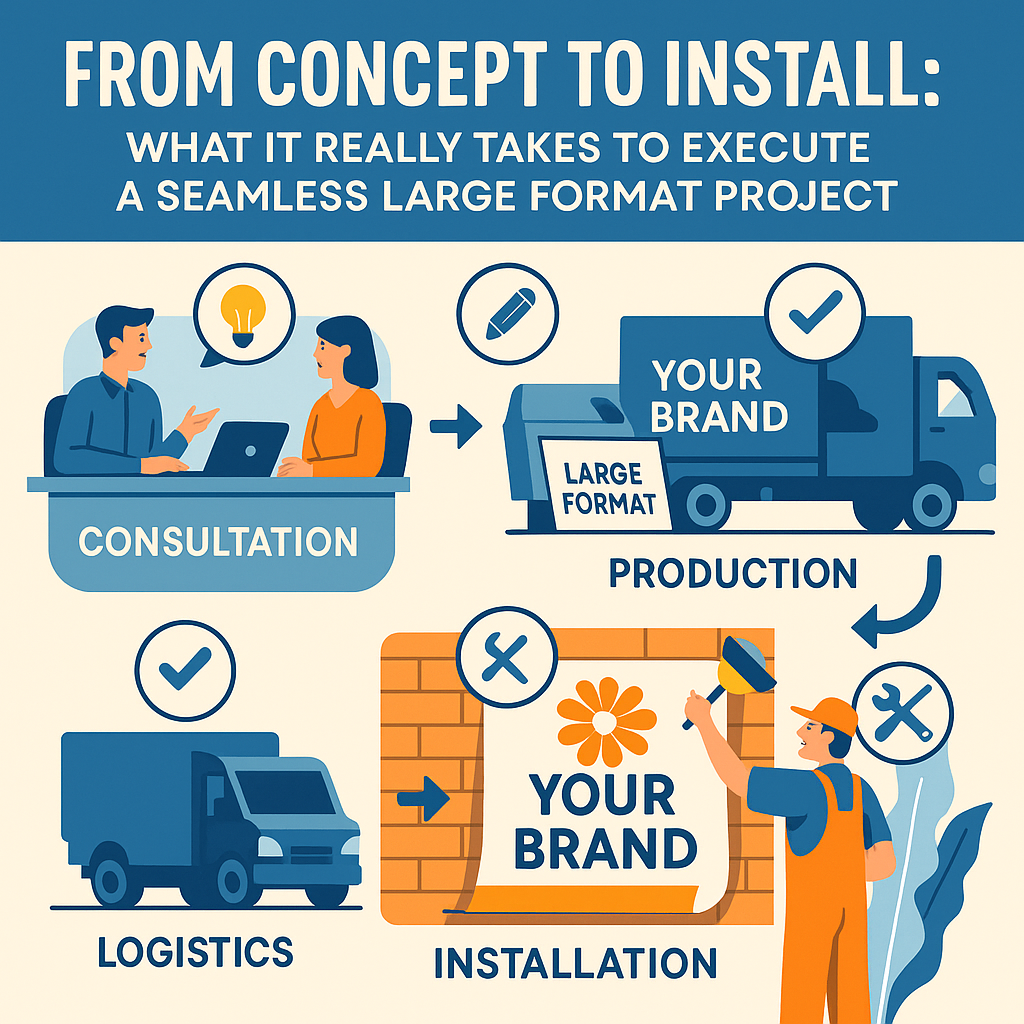
From Concept to Install: Executing a Seamless Large Format Project

Posted: July 29, 2025

Large format printing can be a game-changer for your brand. When you’re looking to captivate attention at an event, transform a retail space, or create lasting impressions with dynamic signage, large format print delivers big impact. But behind every stunning banner, wall mural, or branded window cling, there’s a well-orchestrated process that ensures flawless execution from start to finish.

At JTS, we know that large format printing isn’t just about ink and materials. It’s about delivering a brand experience. So, here’s a behind-the-scenes look at what it really takes to bring your big ideas to life.

Step 1: Discovery and Strategy

Every successful project starts with a conversation. We want to understand your goals, audience, timeline, and budget. Are you trying to drive foot traffic? Promote a product launch? Enhance your workspace? These answers help shape the strategy and the ways we can help execute that strategy.

We also evaluate the installation environment: indoors or outdoors? Wall, floor, glass, or freestanding? Environmental factors help us recommend the right materials and finishes for durability, safety, and visual appeal.

Step 2: Creative and Design

Next, we collaborate on design. If you have brand assets ready to go, great! If not, our design team can create bold, on-brand visuals optimized for large-scale impact. Large format design requires special attention to scale, resolution, and readability from various distances. It’s not just about making something bigger. It’s about making it work better at scale. We ensure color accuracy, clarity, and consistency across all components, and we’ll provide proofs and mockups for review.

Step 3: Material Selection and Printing

Choosing the right materials is key. We frequently use vinyl, fabric, mesh, foam board, or acrylic and each has its own strengths depending on use, environment, and longevity needs.

Our team will advise on:

  • Durability: Will it hold up outdoors? Resist wear and tear?
  • Finish: Matte, gloss, textured, or specialty finishes?
  • Installation: Adhesive-backed? Mounted? Framed or hanging?

Once materials are chosen, your design goes into production using high-resolution, large format printers that ensure color fidelity and precision.

Step 4: Quality Assurance

Before anything ships or installs, we run a comprehensive quality check. We review color accuracy, trim, finish, and overall print integrity. If it doesn’t meet our standards, it doesn’t go out the door. Period.

We also package your materials for safe delivery, ensuring they arrive in perfect condition and ready for installation.

Step 5: Installation and Execution

Installation can make or break your large format project. Our experienced team handles everything from simple banner setups to complex, multi-surface installations.

We coordinate logistics, secure permits (if needed), and schedule around your availability. Our crew ensures:

  • Accurate placement
  • Seamless finishes
  • Safety compliance

When installation is complete, we walk the site with you to ensure everything meets expectations.

Peace of Mind from Start to Finish

Large format projects don’t have to be stressful. At JTS, we handle every detail so you can focus on results. From creative to installation, our streamlined process ensures on-time delivery, brand consistency, and marketing success.

Beyond Banners: 9 Unexpected Ways to Use Large Format Printing to Amplify Your Brand

Want to go beyond the basics? Large format printing can be used creatively in ways you may not have considered. Here are nine high-impact ideas:

  1. Floor Graphics – Turn your floors into branded real estate with decals for wayfinding, promotions, or immersive experiences.
  2. Window Clings – Transform glass into advertising space or create privacy while letting in natural light.
  3. Wall Murals – Tell your brand story with large-scale art or photo murals that make a statement in offices or retail.
  4. Pop-Up Displays – Ideal for trade shows and events; easy to transport, assemble, and make a bold impression.
  5. Vehicle Wraps – Take your message on the road with branded car, truck, or van graphics.
  6. Dimensional Signage – Add depth with 3D letters or elements made from acrylic, foam, or metal.
  7. Event Backdrops – Create Insta-worthy photo ops or branded stage setups for any event.
  8. Building Wraps – Go big with full-facade graphics that demand attention.
  9. Outdoor Wayfinding Signs – Combine branding with function to guide visitors at events, campuses, or business parks.

Ready to Think Big?

Whether you’re planning a simple sign or a full-scale branded environment, JTS has the experience and expertise to bring your large format vision to life. Let’s make something big together. Contact us today to start your next project.